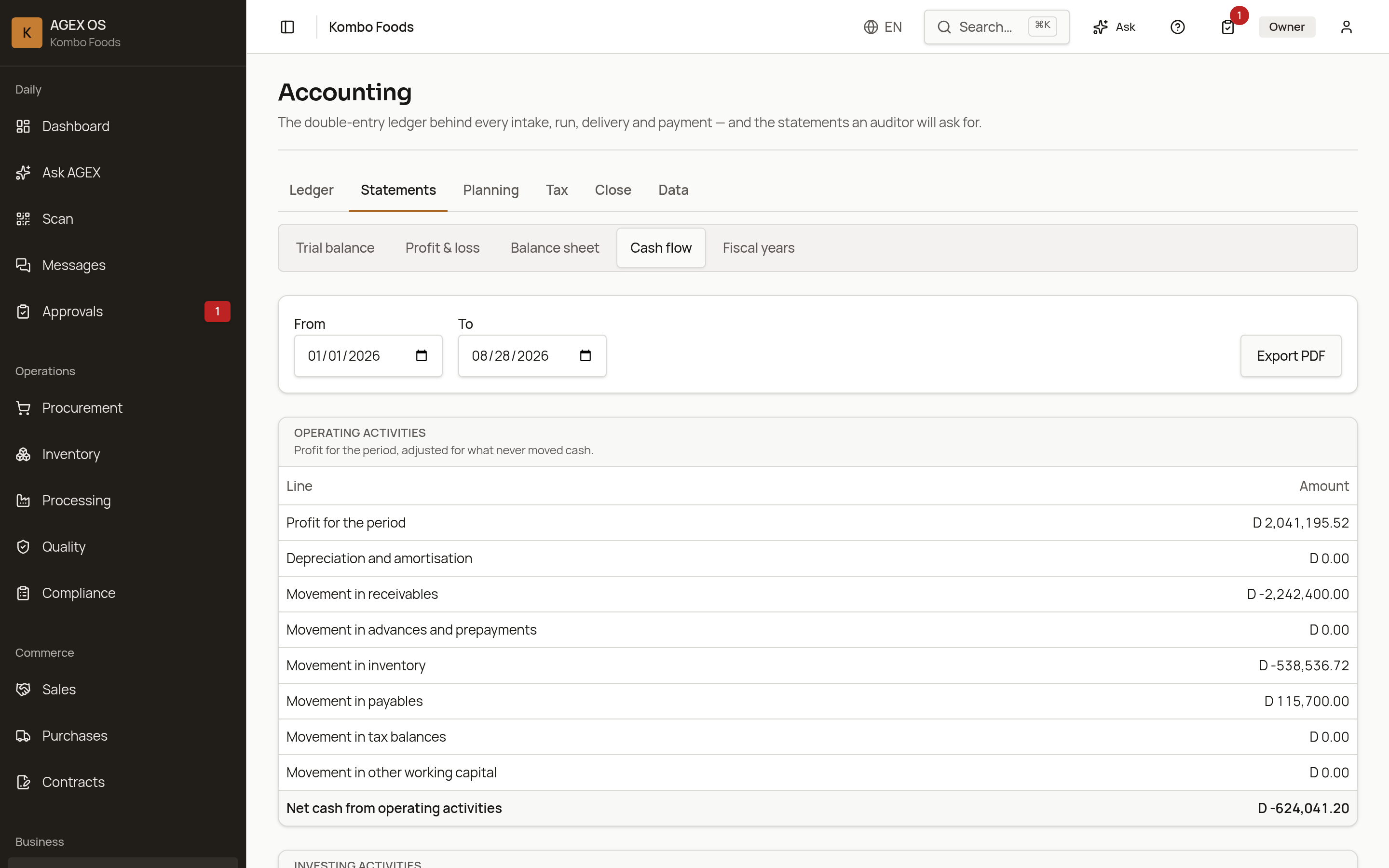
The books close on the same records the scale wrote.
Most of this list is what a processor buys a second system for. It is in AGEX OS, posting from the intake, the run and the invoice — which is the only reason the month-end figure and the factory floor figure agree.
Bring your existing books across — and rehearse it before anything is written.
Opening balances, unpaid customer invoices, unpaid supplier bills, supplier advances and outstanding loans are loaded from a sheet. You rehearse the load first and read exactly what it would post; nothing reaches the ledger until you commit it, and a commit can be undone in one action.
- Rehearse, then commit
- The rehearsal reports every row that will not load and what it would post for the ones that will. Rows that fail are listed with the reason; the valid rows can still go on.
- Undo the whole load
- A committed migration is reversed as one transaction — every entry it made comes back out, and the trail keeps both.
- Opening balances, guided
- Owner capital, a bank loan and the cash and bank you actually started with, entered through a guided screen that balances as you go.
- Loaded twice, caught once
- Duplicate protection on every route in, so a sheet sent again does not double your opening figures.
Append-only double entry. Nothing is quietly edited.
Every intake, run, transfer, invoice and payment posts a balanced journal as it happens. A submitted document is immutable; a correction is a cancel and an amend, and both stay on the trail.
- Chart of accounts
- Classified accounts, journals, trial balance, profit and loss and balance sheet.
- Reversals in period
- A cancellation reverses in the period it was posted, so a closed month never moves.
- Multi-currency
- Transactions in the currency they happened in, reported in yours.
- Audit trail
- Who posted what, from which document, with the source rows attached.
The close is a checklist the system runs, not a weekend.
Prepayments, accruals, revaluation and recurring entries are posted from rules you set once, each with its own journal you can open.
- Prepayments and accruals
- Schedules that release month by month, posted automatically and visible before they post.
- FX revaluation
- Open balances revalued at your closing rate, with the gain or loss on its own account.
- Recurring journals
- Rent, depreciation, standing charges — defined once, posted on the calendar.
- Period control
- Close a period and it stops accepting postings, for everyone, in the database.
Statements, dunning and a credit limit that actually stops a sale.
The money owed to you is chased on a schedule rather than when somebody remembers, and the customer sees the same figures you do.
- Ageing
- Receivable and payable ageing by bucket, drillable to the invoice.
- Statements
- A branded statement per customer, emailed or printed, tying back to the ledger.
- Dunning notices
- Staged reminders as an invoice ages, sent and logged against the customer.
- Credit limits
- A customer over their limit is blocked at the document, not warned at the screen.
Cash flow you can read, and a bank reconciliation that proposes the match.
Import a statement and the system proposes the matches it is confident about — exact, near, grouped — and shows the difference on the ones it is not.
- Cash flow
- Movement by period from the ledger itself, not a spreadsheet kept alongside it.
- Match proposals
- Amount, date and reference scored together, with rules learned from how you matched before.
- Grouped settlements
- One bank line against several invoices, proposed as a group.
- Reconciliation statement
- Book balance to bank balance, with every unreconciled item listed and aged.
- The bank the money moved through
- Payments name the actual account — Trust Bank current, mobile money, petty cash — so a remittance advice and a reconciliation agree on where the money went.
Every submitted document has a way back, and it is never a delete.
A sale that comes back is a sales return and a credit note against the original invoice. A payment sent to the wrong place is reversed, not erased. A reconciled bank line whose entry was later cancelled is flagged on the statement rather than left looking matched.
- Returns and credit notes
- Goods back into stock at the batch they left on, a credit note against the invoice, and the customer's balance reduced by it.
- Cancel and reverse
- Cash counts, stock transfers, goods receipts, receipt allocations, supplier advances and licence payments each have their own reversal, posted in the period the original hit.
- Changed a closed month?
- If a correction touches a month that is already closed, the screen says so before you post and names the month that has to be reopened.
- Who may undo what
- Reversals carry their own permissions and a written reason — undoing a bank reconciliation is not the same right as doing one.
What a contract, a container or a run actually cost you.
Costs carry the dimension they were incurred against, so margin is a query rather than an argument.
- Contract costing
- Intake, processing, freight and charges gathered against the contract they belong to.
- Container costing
- Landed cost per container, per batch, per kilo.
- Conversion cost
- Labour, energy and consumables split across the outputs of a processing run.
- Fixed assets
- Capitalisation, depreciation schedules and disposals, posted to the ledger.
Returns and exports in the shape your accountant asked for.
Filing stays a human act; preparing the pack does not.
- VAT and withholding
- Return packs from the ledger, with withholding certificates per supplier.
- Sage and QuickBooks
- Scheduled export of the ledger in the format those systems import.
- Budgets and cost centres
- Budget against actual by centre, from the same postings.
- Year-end close
- Retained earnings rolled and the year locked, on the trail like everything else.
What the close actually looks like.
Captured from a working book: a month of cash, an ageing, a reminder waiting to be sent, the schedules that release on their own, a revaluation and a bank statement being matched off.